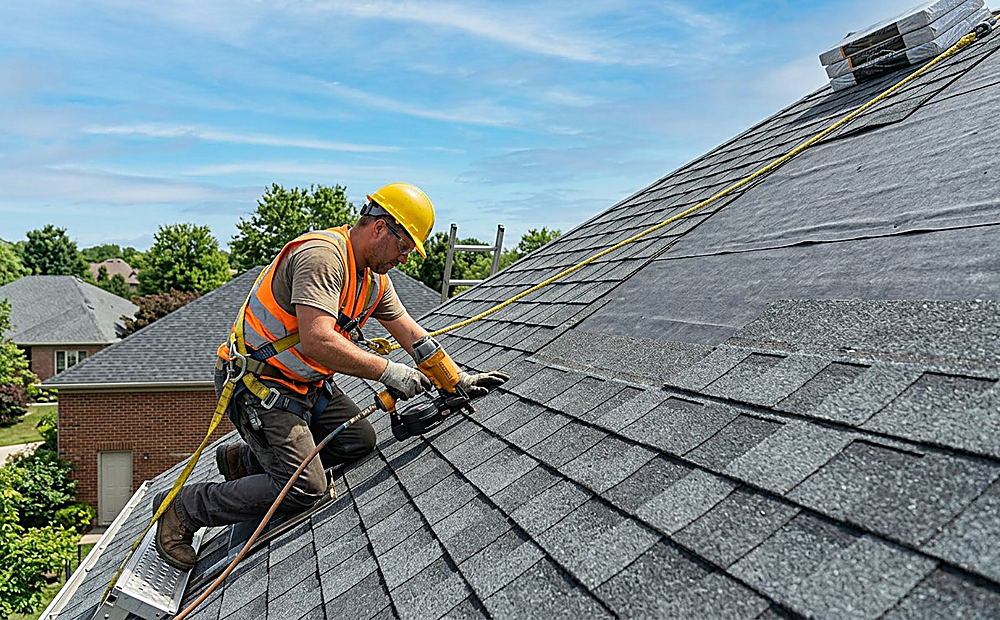
Your roof works every hour of every day, quietly shedding rain, snow and sun. It also gives plenty of warning before it fails — the difficulty is that most of those warnings appear in places homeowners do not routinely look. A short seasonal habit closes that gap.
Why roofing rewards a routine
Roofs age in layers. Granules loosen, sealant dries, flashing lifts a fraction, and gutter debris holds moisture against the edge of the structure. Individually these are small things. Together they are the story of most roof leaks, and every one of them is cheaper to correct early than after it has reached the ceiling below.
What to check from the ground
You do not need to climb anything to spot useful information. Stand back with a pair of binoculars and work methodically across the slope.
- Shingle edges that look curled, cracked or darker than their neighbours.
- Bare patches where granules have washed away, leaving the matting exposed.
- Rust streaks on flashings, or gaps where the roof meets a chimney, vent or wall.
- Sagging in the roofline, which can point to trapped moisture underneath.
- Gutters holding debris, staining down the fascia, or dripping long after the rain stops.
Look up after every storm
A quick walk around the house after heavy wind or hail takes minutes and catches displaced shingles, gutter damage and fallen branches before the next rain drives water into the structure.
A seasonal rhythm that keeps roofs healthy
Spring
Clear winter debris, check that gutters run free, and inspect the attic for daylight or damp staining after the wet months. Early spring is also the best moment for the small repairs that protect you through summer storms.
Summer
Heat tests sealants and flashing. Check around skylights, vents and chimney surrounds, and confirm that attic ventilation is moving air — a hot, breathless attic ages roofing from below as surely as sun ages it from above.
Autumn
Leaves are the enemy of drainage. Clear gutters and downspouts, trim overhanging branches and photograph anything that looks worn, so you can compare it after the next weather front passes through.
Winter
Ice is a structural test. Watch for icicles forming a line along an eave and for moisture inside the house after freeze-thaw cycles. Both are worth a professional look rather than a wait-and-see approach.
Signs it is time to call us
Patching is sensible when the roof has years of life left in it. It is not sensible when the same area keeps leaking, when shingles are brittle across a whole slope, or when the roof has already been repaired repeatedly. At that point, money spent on fixes is money that would have gone towards the replacement.
When we assess a roof we report what we find in plain language with photographs, then outline both routes: repair with a realistic remaining-life estimate, or upgrade with material choices suited to your home's pitch, ventilation and climate exposure.
Upgrading rather than patching
A roofing upgrade is the moment to correct the things a repair cannot reach: improve ventilation, add underlayment where it is thin, replace tired flashing properly, and choose a shingle or standing-seam profile that suits the architecture. Because we also install solar and replace windows, we can plan the roof and the renewable upgrades as one weather-tight system instead of two projects that fight each other.